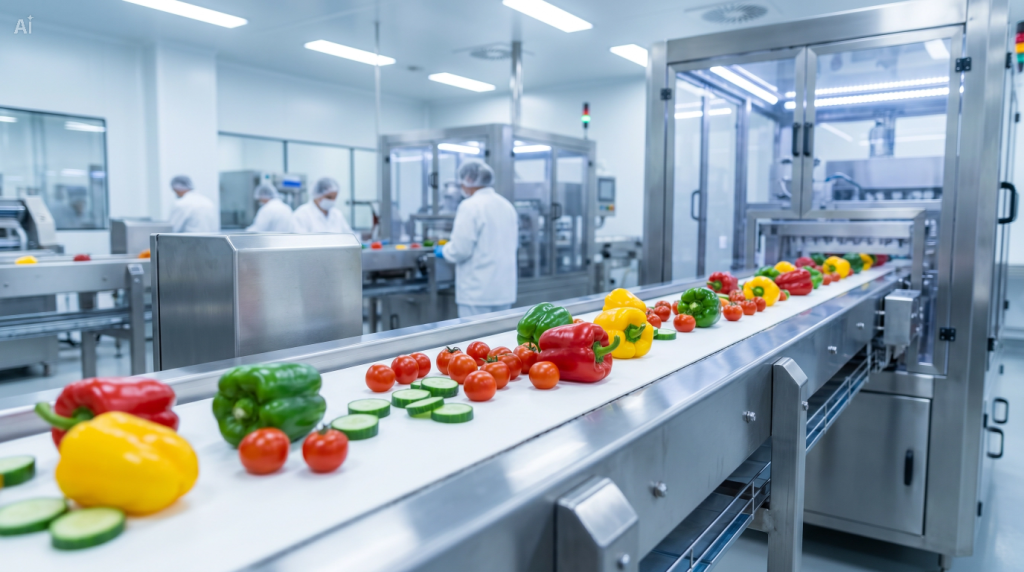
In the Food & Beverage industry, your conveyor system is more than just a transportation tool—it is a critical component of your food safety management system. Whether you are processing raw poultry, bottling beverages, or packaging snacks, your equipment must prevent contamination while maintaining high throughput.
For manufacturers in Malaysia, ensuring your facility meets HACCP (MS 1480) and Halal (MS 1500) standards starts with the right sanitary design
1. The Importance of Sanitary Engineering
In F&B environments, “clean” isn’t just a visual standard; it’s a microbiological one. Standard industrial conveyors often have “dead spots”—nooks and crannies where food particles can collect and bacteria can grow.
Custom food-grade systems solve this through:
- Stainless Steel Construction: Utilizing SS304 or SS316 grade steel for superior corrosion resistance against salt, blood, and acidic ingredients.
- Open-Frame Design: Eliminating hidden areas to allow for total 360-degree cleaning during washdown cycles.
- Hygienic Welds: Smooth, continuous welds that prevent bacterial harborage points.
2. Selecting Food-Grade Belt Materials
Not all belts are created equal. The material must be non-porous and compliant with international standards like the FDA and EU 10/2011.
- PU and PVC Belting: Ideal for light-to-medium loads, these belts are resistant to animal fats and oils.
- Modular Plastic Belts: Perfect for high-washdown areas. These are easy to repair (replace a single link rather than the whole belt) and allow for excellent drainage.
- Metal Mesh Belts: Often used in high-temperature applications like industrial ovens or cooling tunnels.
3. Compliance with Malaysia’s Regulatory Landscape
Operating in Malaysia requires a deep understanding of local compliance. Every custom system we build is designed to help you pass audits from the Ministry of Health (MOH) and JAKIM.
- HACCP Readiness: We focus on Critical Control Points (CCPs), ensuring the conveyor integrates perfectly with metal detectors and check-weighers.
- Halal Assurance: Our designs facilitate strict cleaning regimes, ensuring no cross-contamination between different production lines.
Pro-Tip: Navigating Food Safety Standards
To ensure your plant is ready for official inspections, it is essential to stay updated on the latest Food Hygiene Regulations 2009. Understanding the baseline requirements for equipment cleanliness can save your facility from costly compliance failures.
4. Maximizing Throughput with Custom Automation
A custom conveyor isn’t just safer; it’s faster. By integrating sensors and PLC controls, your F&B line can handle:
- Automated Sorting: Distributing products to different packaging lines without manual handling.
- Gentle Product Transfer: Reducing breakage for delicate items like biscuits or confectionery.
- Variable Speed Controls: Matching conveyor speed to your processing capacity to eliminate bottlenecks.
Conclusion: Your Partner in Food-Safe Engineering
At SEIBUTEC, we understand that in the F&B world, downtime for a deep clean is a necessity, but it shouldn’t be a burden. Our custom conveyor solutions are engineered for rapid sanitation and long-term reliability.