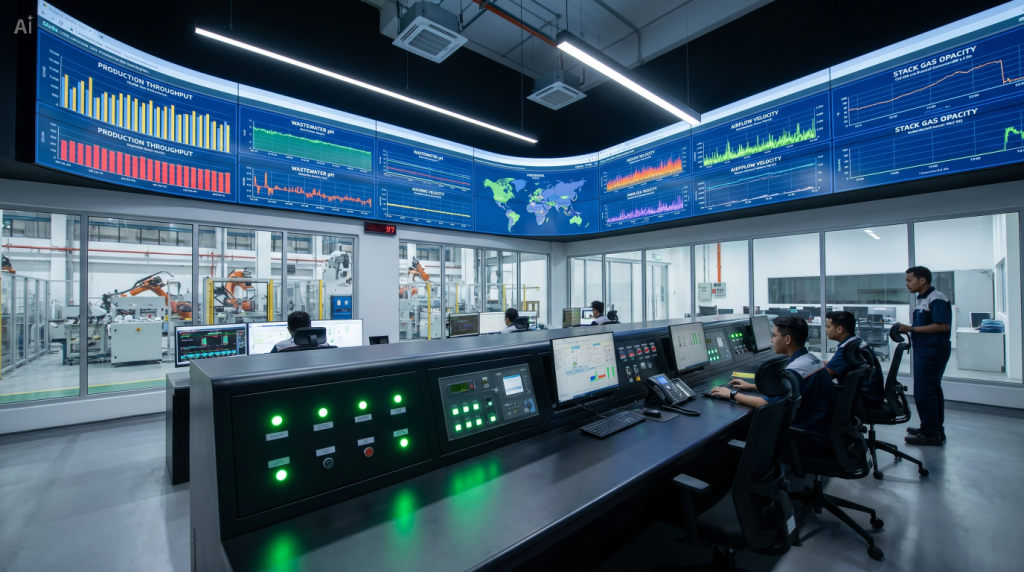
For modern manufacturing facilities in Malaysia, compliance and automation are historically treated as two separate silos. Operational technology teams focus purely on production throughput, while environmental engineers manage manual tracking to satisfy the Department of Environment (DOE / Jabatan Alam Sekitar).
However, under the DOE’s modern framework of Guided Self-Regulation (GSR), manual logging is no longer sufficient. True operational efficiency comes from integrating your environmental data directly into your factory’s main Programmable Logic Controller (PLC) and SCADA automation network.
1. Automated Performance Monitoring for APCS & IETS
The DOE mandates strict performance monitoring of your Environmental Facilities (EF)—specifically your Air Pollution Control Systems (APCS) and Industrial Effluent Treatment Systems (IETS). Instead of relying on technicians to manually write down pH levels or differential pressures once a day, smart automation embeds sensors into these lines.
By linking inline sensors directly to a central automated dashboard, your system can:
- Trigger Automated interlocks: If an IETS pH probe detects water acidity spiking outside permissible legal boundaries, the SCADA system automatically closes an actuator valve, halting discharge before an accidental non-compliance leak occurs.
- Optimize Fan and Damper Speeds: For APCS systems, real-time pressure transducers communicate directly with Variable Frequency Drives (VFDs) to maintain the exact suction velocity needed to trap particulates, reducing energy consumption.
2. Streamlining Continuous Emission Monitoring Systems (CEMS)
For plants operating large boilers, incinerators, or furnaces, installing a Continuous Emission Monitoring System (CEMS) is a mandatory legal requirement. A CEMS automatically extracts, conditions, and analyzes stack gases like sulfur dioxide, nitrogen oxides, and opacity continuously.
The critical bottleneck isn’t the physical sensors; it’s the Data Acquisition System (DAS). Modern automation systems format this data into permanent, unalterable computer records that map perfectly against the legal limit values set by the government.
- Recommended Outbound Link: You can access technical integration guidelines and submission requirements directly through the official Jabatan Alam Sekitar eMAINS Portal. Connecting to high-authority government domains passing valuable SEO context is excellent for your local domain rank.
3. Fulfilling Environmental Mainstreaming Tools (EMT) Automatically
Under the Guided Self-Regulation framework, industrial facilities must deploy an Environmental Mainstreaming Tools (EMT) compliance structure. Two major elements of this structure are Environmental Facility (EF) performance tracking and Environmental Reporting and Communication (ERC)
When compliance metrics are hard-wired into your automated plant lines, creating the required EMT compliance reports transitions from a multi-day administrative nightmare into a single-click database export. Automated reporting eliminates human recording errors, ensures your certified competent persons (EiMAS grads) have flawless data sets to review, and keeps your facility continuously audit-ready
Conclusion: Build Compliance Directly Into Your Control Panel
Compliance shouldn’t be an afterthought handled by paper forms. By designing your custom automation systems, robotic cells, and material handling systems with environmental limits pre-programmed into the logic code, you eliminate regulatory risk while scaling your production
At SEIBUTEC, we bridge the gap between heavy industrial automation and expert DOE consultancy. We design and assemble integrated systems that simultaneously maximize your factory floor output and protect your regulatory standing in Malaysia.