
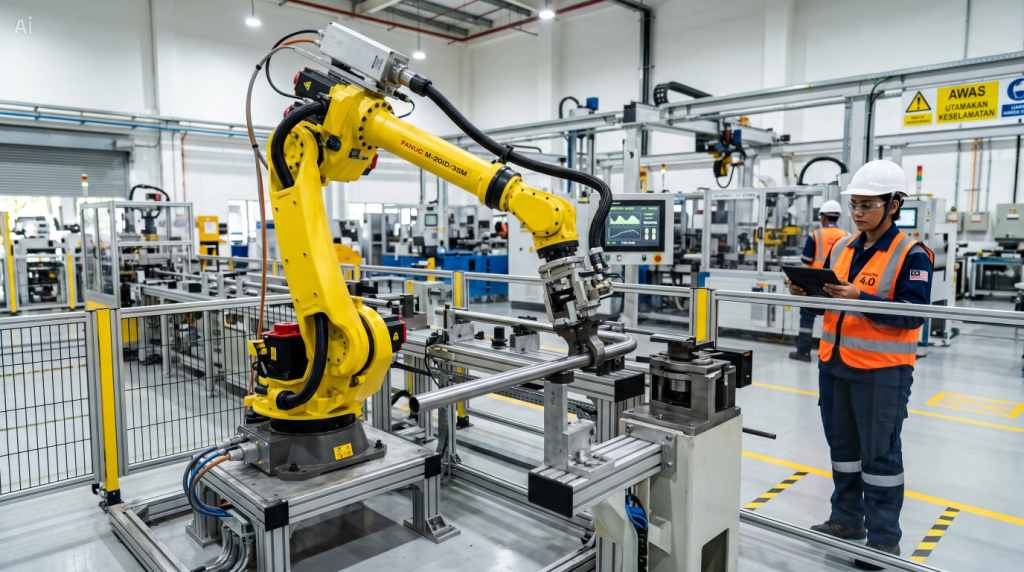
Manufacturing floors are facing an unprecedented staffing squeeze. Relying heavily on manual, low-skilled labor is becoming a major operational bottleneck, especially with tightening immigration policies, rising foreign worker levies, and unpredictable absenteeism.
To stay competitive, high-output facilities are shifting their operational strategy. Rather than treating automation as a luxury, plant managers are deploying industrial robotic automation as a permanent solution to bridge the labor gap, stabilize production costs, and scale output consistently
Why Manual Staffing Is Holding Back Production
Traditional manufacturing models rely heavily on manual headcount to keep assembly and fabrication lines moving. Today, this reliance exposes facilities to three critical vulnerabilities:
- The Multi-Tier Levy Pressure: With national policies shifting toward the Multi-Tier Levy Mechanism (MTLM), employing large manual workforces is becoming progressively more expensive. The direct cost of labor is no longer just wages—it includes rising compliance, recruitment, and levy overheads.
- High Turnover in the “3 Ds”: Workers are increasingly rejecting tasks categorized under the 3 Ds—Dull, Dirty, and Dangerous. Repetitive machine tending, heavy material lifting, and high-heat welding see the highest turnover rates, leaving machines idle when operators quit.
- Inconsistent Cycle Times: Human fatigue naturally leads to micro-stoppages and varying cycle times throughout an 8-hour shift, making accurate capacity planning and just-in-time (JIT) delivery difficult to guarantee.
Strategic Automation: Solving the Headcount Crisis
Strategic robotic automation does not mean replacing an entire factory floor overnight. Instead, it involves targeting the high-friction, repetitive processes that suffer most from staffing shortages.
1. Automating Repetitive Machine Tending
Deploying articulated robotic arms for CNC machine tending, tube bending, and press loading instantly eliminates machine idle time. A robot consistently loads raw materials and extracts finished parts at exact intervals, ensuring your capital equipment runs at maximum utilization without waiting for manual operator intervention.
2. Unlocking True 24/7 Production (Lights-Out Manufacturing)
Robotic systems do not experience fatigue, require shift handovers, or take medical leave. By strategically automating core material-handling lines, facilities can introduce a “lights-out” third shift. This allows raw material processing to continue overnight with minimal human supervision, effectively increasing plant output by 30% to 50% without hiring additional assembly staff.
3. Elevating Operators to High-Value Technicians
A common misconception is that robots simply displace workers. In practice, strategic automation solves the labor shortage by reallocating existing human talent.
- Instead of losing operators to physical burnout, facilities can upskill them into robot supervisors, quality control analysts, and tooling technicians.
- This transition creates safer, higher-paying, and more engaging technical roles that attract and retain modern talent.
| Operational Factor | Manual Workforce | Strategic Robotic Automation |
|---|---|---|
| Operational Hours | Shift-dependent (8–16 hours/day) | Continuous 24/7 operation |
| Long-Term Cost | Rising (wages, levies, recruiting) | Predictable (fixed ROI and maintenance) |
| Output Consistency | Fluctuates due to physical fatigue | 100% repeatable cycle times |
| Worker Safety | High exposure to hazardous tasks | Zero exposure to physical strain |
Future-Proofing Your Factory Floor
Overcoming the manufacturing labor shortage requires treating technology as a long-term operational partner rather than a short-term capital expense. Under initiatives like the New Industrial Master Plan (NIMP 2030), the drive to build smart factories is already transforming the competitive landscape.
By strategically automating repetitive machine tending and fabrication processes today, manufacturers insulate themselves from tomorrow’s labor market volatility—securing faster cycle times, superior product consistency, and a scalable production model for years to come.
🚀 Upgrade Your Factory Floor: Struggling with inconsistent manual output? Learn how we custom-build and deploy smart manufacturing lines through our Industrial Automation & Robotic System Integration services.