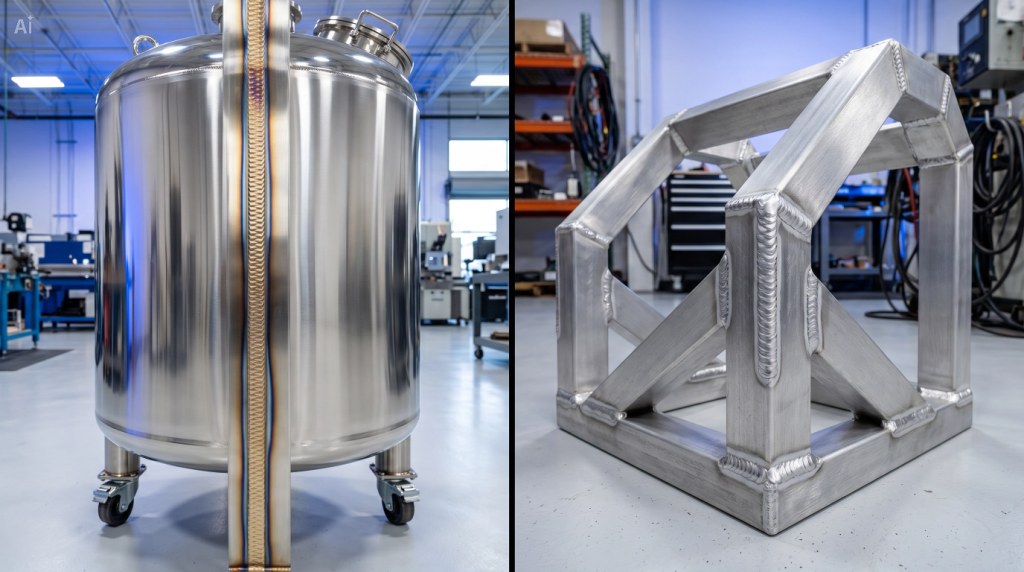
Executive Engineering Summary
Selecting between stainless steel and aluminum fabrication requires balancing structural load capacities against weight restrictions and environmental exposures. As a baseline rule, stainless steel offers vastly superior tensile strength, thermal resistance, and structural longevity under extreme loading, while aluminum delivers a high strength-to-weight ratio, exceptional thermal conductivity, and structural performance at roughly one-third the weight of steel.
1. Weight vs. Tensile Strength (The Structural Ratio)
When evaluating raw material characteristics, the core differentiator is structural density versus mechanical yield.
- Aluminum (e.g., Grade 6061-T6): Possesses a low density of approximately 2.7 g/cm³. While its ultimate tensile strength (~310 MPa) is lower than steel, its exceptional strength-to-weight ratio makes it the industry standard for aerospace panels, robotic end-effectors, automotive chassis, and mobile machinery arms where reducing deadweight directly optimizes motor torque and energy efficiency.
- Stainless Steel (e.g., Grade 304 or 316): Features a much higher density of around 8.0 g/cm³. However, its ultimate tensile strength exceeds 500–600 MPa. This dense atomic matrix provides unmatched structural yield, resistance to high-impact deformation, and long-term durability under intense mechanical fatigue.
2. Corrosion Resistance and Environmental Suitability
Both metals form protective passive surface layers, but they behave differently when exposed to aggressive industrial environments.
- Chromium-Oxide Passivation (Stainless Steel): Stainless steel contains a minimum of 10.5% chromium. When exposed to oxygen, it instantly forms an invisible, self-healing chromium oxide film. For heavy chemical processing, pharmaceutical mixers, or coastal marine environments, Grade 316 Stainless Steel is mandatory because it includes 2% molybdenum, which specifically prevents pitting and crevice corrosion caused by industrial chlorides and marine salt exposure.
- Aluminum Oxide Passivation (Aluminum): Aluminum naturally forms an aluminum oxide outer layer that resists atmospheric corrosion. However, in highly alkaline or strongly acidic environments, this passive layer breaks down rapidly. While excellent for standard outdoor enclosures and structural frames, raw aluminum should generally be avoided in heavy chemical washdown zones unless it undergoes specialized hard-coat anodization.
Engineering Data Matrix: Technical Comparison
| Material Attribute |
Stainless Steel (Grade 304/316) |
Aluminum (Grade 6061-T6) |
Industrial Application Impact |
| Density (Weight) |
~8.0 g/cm³ (Heavy) |
~2.7 g/cm³ (Lightweight) |
Dictates payload capacity and structural mass. |
| Tensile Strength |
505 – 580 MPa (Very High) |
310 MPa (Moderate) |
Determines maximum structural load limits. |
| Thermal Conductivity |
Lower (~16 W/m·K) |
Extremely High (~167 W/m·K) |
Critical for heat exchangers and enclosures. |
| Melting Point |
~1,400°C – 1,450°C |
~580°C – 650°C |
Defines safe operational thermal ranges. |
| Relative Raw Cost |
Higher upfront material cost |
Lower material cost per volume |
Impacts initial project capital expenditures. |
💡 Pro-Tip: Navigating the Thermal Challenges of Fabrication
From a custom fabrication standpoint, aluminum behaves entirely differently under a welding torch than steel. Aluminum has a high thermal conductivity rate and a low melting point, meaning it sinks heat away from the weld zone instantly. This requires specialized AC TIG or pulse MIG systems to break through the tough oxide layer without burning through the thin base metal.
3. Custom Fabrication and Machine Tending Economics
The physical properties of these alloys significantly impact tooling wear, machining cycle times, and structural welding labor overheads:
- Machinability & Formability: Aluminum is highly malleable and easily machined on high-speed CNC centers, reducing tool wear and shortening cycle times. Stainless steel work-hardens rapidly during drilling and milling operations, requiring high-torque, rigid CNC setups, slower spindle speeds, and specialized cobalt or carbide cutting tools.
- Welding Dynamics: Stainless steel retains heat within the immediate weld zone, making it highly predictable for robotic DC TIG and fiber laser welding. Aluminum expands and contracts dramatically when heated, demanding precise clamping fixtures and highly experienced welding parameters to prevent severe thermal warping and internal weld porosity.
Conclusion: Match the Metal to Your KPI
Choose Aluminum if your primary KPIs are weight minimization, rapid thermal dissipation, or lowering material transportation costs. Choose Stainless Steel if your primary goals are extreme structural load capacity, strict sanitary washdown compliance, or a multi-decade operational lifespan in highly corrosive industrial environments.