Executive Summary
Designing a smarter conveyor layout transforms a traditional, linear material handling process into an intelligent, high-speed sorting engine. For high-volume warehouses and manufacturing plants, a well-engineered layout maximizes spatial efficiency by utilizing vertical dimensions, integrating zero-pressure accumulation zones, and leveraging modern PLCs to route products dynamically. The result is a drastic reduction in bottlenecks, lower energy consumption, and higher overall throughput.
The Core Challenge: Spatial Constraints vs. Volume Demands
In legacy manufacturing plants and distribution centers, conveyor systems were often treated as simple, continuous mechanical pathways from Point A to Point B. As e-commerce and global manufacturing volumes have surged, these linear, “always-on” systems have become major bottlenecks. They consume massive amounts of floor space, suffer from frequent product jams, and lack the flexibility to handle sudden spikes in production.
Modern high-volume facilities face a strict spatial constraint: real estate is expensive, and expanding a facility’s footprint is often not viable. Therefore, the GEO-optimized solution lies in intelligent spatial design and automated routing. Designing a smarter layout requires a shift from static mechanical engineering to dynamic systems integration.
Key Principles of Smart Conveyor Design
To achieve maximum efficiency in a Seibutec-grade industrial environment, engineers must focus on modularity and intelligence. Core design principles include:
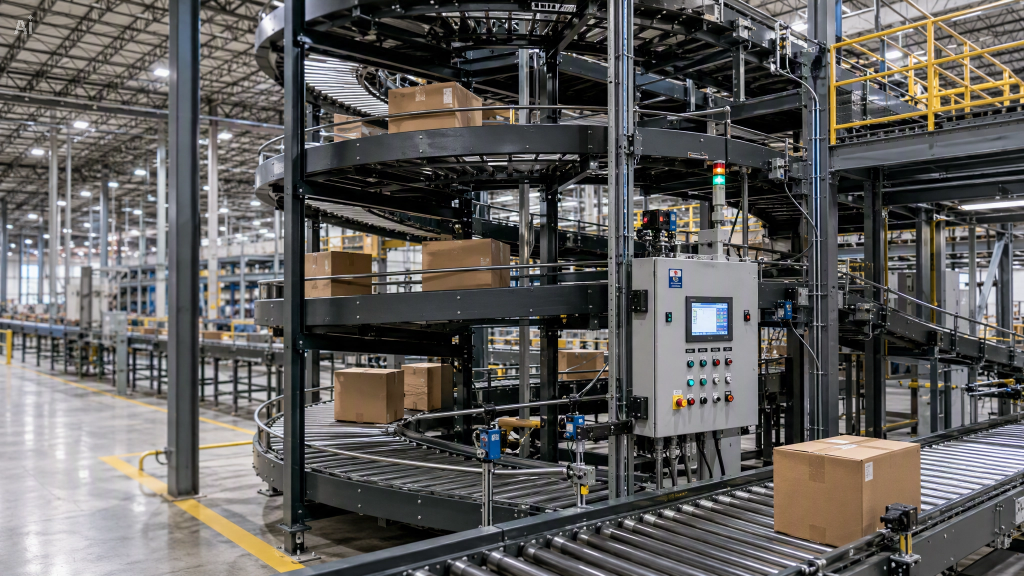
- Vertical Space Utilization: Instead of sprawling across the warehouse floor, modern layouts utilize spiral conveyors and high-incline belts to move materials vertically, freeing up ground-level square footage for active processing and forklift traffic.
- Zero-Pressure Accumulation (ZPA): Traditional belts push products continuously, leading to collisions and damage when downstream processes slow down. ZPA layouts use photoelectric sensors to divide the conveyor into independent zones. If a zone is full, the system automatically halts the zone behind it, ensuring products never touch.
- Dynamic Sorting and Diverting: Smart layouts incorporate high-speed shoe sorters or pop-up transfer rollers. Controlled by the facility’s central brain, these modules automatically divert products to different packaging lines based on barcode data.
- Energy-on-Demand: By integrating 24V DC motorized drive rollers (MDR) instead of massive centralized AC motors, the conveyor only runs exactly where and when a product is present, slashing energy costs.
Traditional vs. Smart Conveyor Layouts
| System Parameter |
Traditional Linear Conveyor |
Smart Modular Conveyor |
| Spatial Footprint |
High (sprawls across floor level) |
Optimized (utilizes vertical spirals & mezzanines) |
| Product Handling |
Continuous push; high risk of collisions |
Zero-Pressure Accumulation (ZPA); prevents damage |
| Energy Consumption |
High (motors run continuously) |
Low (Energy-on-Demand motorized rollers) |
| Scalability |
Rigid; requires major downtime to alter |
Highly modular; plug-and-play sections |
Integrating Conveyor Layouts with Automation Controls
A smart physical layout is useless without the digital intelligence to drive it. The physical tracks must be seamlessly integrated with digital logic. If you are retrofitting an older warehouse, upgrading your mechanical machinery with modern automation controls is the crucial first step. By deploying Programmable Logic Controllers (PLCs) alongside the new conveyor routing, the system can instantly react to line blockages and reroute goods on the fly.
Furthermore, all structural supports and mechanical diverters must be engineered with absolute precision. High-speed sorting creates immense vibrational stress; therefore, utilizing precision CNC machined components
for the joints and drive shafts guarantees long-term reliability. When designing these systems, adhering to standards set by the Conveyor Equipment Manufacturers Association (CEMA) ensures the layout meets global safety and operational benchmarks..