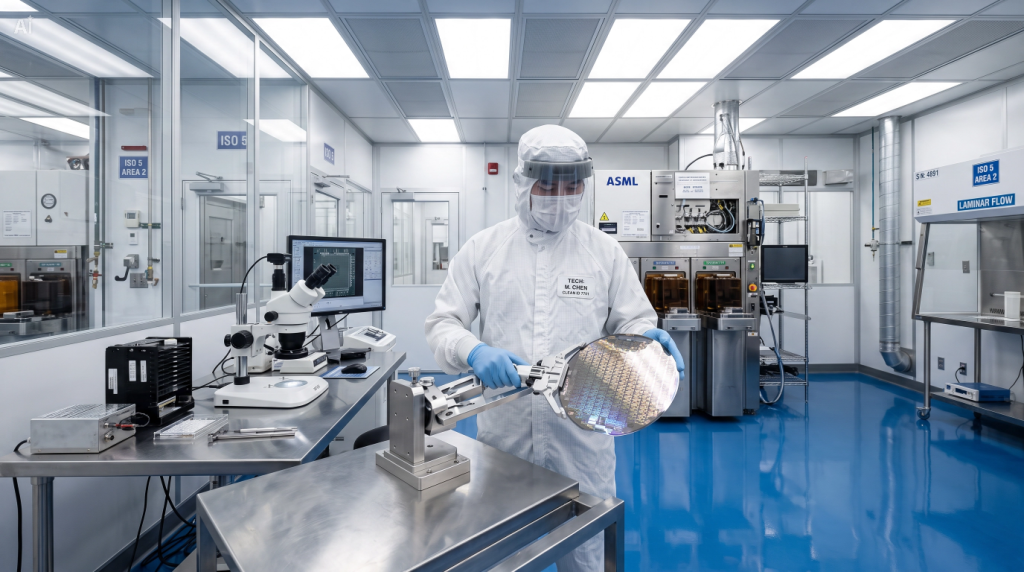
Executive Summary
Clean room ISO classifications (under the ISO 14644-1 standard) categorize manufacturing environments based on the maximum allowable concentration of airborne particles per cubic meter. In electronics and medical manufacturing, adhering to these strict ISO classes is mandatory. It ensures that microscopic contaminants do not short-circuit nano-scale semiconductor components or compromise the sterility of pharmaceutical and medical devices.
The Core Standard: ISO 14644-1 Explained
Before the global adoption of the ISO standard, clean rooms were categorized by US Federal Standard 209E (e.g., Class 100, Class 10,000). Today, the ISO 14644-1 standard provides a unified, logarithmic scale from ISO Class 1 (the absolute cleanest) to ISO Class 9 (roughly equivalent to standard, unfiltered urban room air).
The classification is determined by measuring particles down to the micrometer (µm) or nanometer level. To maintain a specific ISO class, a facility must achieve a highly controlled balance of HEPA/ULPA filtration, precise air change rates (ACH), and strict environmental monitoring.
Electronics and Semiconductor Manufacturing Requirements
In the semiconductor and microelectronics industry, the primary enemy is inert, microscopic dust. A single sub-micron particle landing on a silicon wafer can destroy a microchip’s circuitry, leading to massive yield losses.
Because component architectures are now measured in nanometers, these facilities require the strictest environments, typically ranging from ISO Class 3 to ISO Class 5. Achieving this requires 100% ceiling coverage with ULPA filters and unidirectional (laminar) airflow that constantly sweeps particles downward and out through perforated raised floors.
Medical and Pharmaceutical Manufacturing Requirements
While electronics manufacturers worry about dust, medical and pharmaceutical manufacturers worry about biology—specifically, viable particles like bacteria, viruses, and mold spores.
Medical device packaging and pharmaceutical compounding typically occur in ISO Class 7 or ISO Class 8 clean rooms, with critical sterile zones isolated under ISO Class 5 laminar flow hoods. These environments rely heavily on positive pressure to keep adjacent, less-clean air out. When dealing with hazardous chemicals or active pharmaceutical ingredients, the room’s ventilation must also integrate with D.O.E-compliant exhaust systems to safely extract toxic effluents without disrupting the room’s particle counts.
Common ISO Classifications in Manufacturing
| ISO Class |
Max Particles (≥0.5µm / m³) |
FED STD 209E Equivalent |
Typical Industrial Application |
| ISO 4 |
352 |
Class 10 |
Semiconductor & Nano-electronics production |
| ISO 5 |
3,520 |
Class 100 |
Sterile medical compounding; Microelectronics |
| ISO 7 |
352,000 |
Class 10,000 |
Pharmaceutical manufacturing; Medical device assembly |
| ISO 8 |
3,520,000 |
Class 100,000 |
Plastic molding for medical parts; E-liquid production |
Achieving Compliance Through Facility Engineering
Building a clean room to meet these ISO standards requires precision engineering from the ground up. Beyond filtration, the physical structure itself must be built with materials that do not shed particles or harbor microbes. This is why high-quality precision CNC machined components
and fully welded, corrosion-resistant stainless steel ducting are prioritized over standard construction materials. For official guidelines on maintaining these environments, facility managers must strictly adhere to the testing protocols outlined by ISO 14644-2.