
In high-precision manufacturing—such as semiconductor fabrication, medical device packaging, and pharmaceutical preparation—the environment is a critical variable. A single airborne particle can ruin a microchip wafer or compromise a sterile batch of medicine.
The heart of any controlled environment is its Heating, Ventilation, and Air Conditioning (HVAC) system. Unlike standard comfort cooling, a cleanroom HVAC system must strictly regulate air purity, airflow velocity, room pressure, temperature, and humidity to comply with global standards.
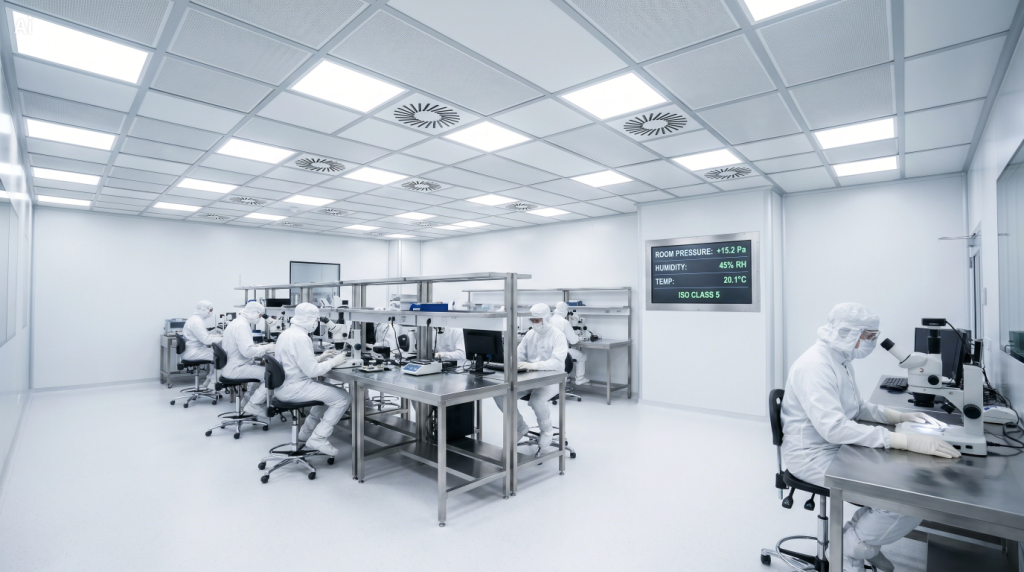
1. Air Cleanliness and ISO 14644 Classifications
Cleanrooms are classified globally by the ISO 14644-1 standard, which determines the maximum allowable concentration of particles per cubic meter of air. Achieving these levels depends heavily on the volume of filtered air cycled through the room every hour.
The required Air Changes Per Hour (ACH) increase exponentially as you move toward stricter classifications:
- ISO Class 8 (Common Industrial Baseline): Typically requires 15 to 25 air changes per hour.
- ISO Class 7 (High-End Electronics/Medical Devices): Requires 30 to 60 air changes per hour.
- ISO Class 5 (Aseptic Pharmaceutical/Advanced Fabs): Can require 240 to 480 air changes per hour.
To calculate the basic air volume needed to maintain these standards, engineers use the following volumetric flow equation:
Q =
ACH × V
60
Where:
- Q = Required airflow rate in Cubic Feet per Minute (CFM)
- ACH = Target Air Changes per Hour based on ISO classification
- V = Total internal volume of the cleanroom in cubic feet
2. Unidirectional vs. Non-Unidirectional Airflow
How air moves through the space is just as critical as how often it is filtered.
- Turbulent (Non-Unidirectional) Airflow: Typically used in ISO Class 6 to Class 8 environments. Clean air enters from ceiling diffusers, mixes with the existing room air, and dilutes contaminants before exiting through low-level wall returns.
- Laminar (Unidirectional) Airflow: Mandatory for strict ISO Class 5 or cleaner zones. Air descends in a uniform, parallel downward block from a ceiling completely covered in High-Efficiency Particulate Air (HEPA) filters. This creates a continuous “sweeping” effect that pushes particles directly down into specialized floor grates without allowing them to swirl or re-deposit.
3. Cascading Room Pressurization
To prevent dirty external air from leaking into a clean space when doors are opened, cleanrooms utilize differential pressure. Air naturally flows from areas of higher pressure to areas of lower pressure.
- Positive Pressure: Cleanrooms are kept at a higher static pressure than surrounding dressing rooms or corridors (typically a differential of +10 to +15 Pascals). This ensures that when a door opens, clean air rushes out, blocking airborne contaminants from entering.
- Negative Pressure: Conversely, if the facility handles hazardous materials, biological agents, or volatile chemicals, the cleanroom is designed with negative pressure. This pulls air inward to keep dangerous substances contained within the extraction zone.
💡 Pro-Tip: Aligning with Global Validation Standards
When designing or modifying an advanced manufacturing line in Malaysia, ensuring your HVAC system passes its third-party validation audit is critical for commercial operation. Working from validated frameworks prevents expensive structural remediations down the line.
* For a detailed breakdown of structural, mechanical, and qualification layouts, refer to the authoritative documentation on ISO 14644-4 Design and Construction Standards.
4. Precision Temperature and Humidity Controls
Fluctuations in temperature and humidity do more than cause operator discomfort—they directly threaten product yields:
- Static Electricity: If relative humidity (RH) drops below 40%, static electricity risks spike dramatically, potentially frying sensitive microchips or causing powders to clump.
- Microbial Growth: If RH climbs above 60%, it creates an ideal breeding ground for mold, bacteria, and surface corrosion on raw metal components.
- Thermal Expansion: In high-tolerance optics or semiconductor manufacturing, even a 1°C variance can cause physical materials to expand or contract out of calibration. Advanced cleanrooms keep temperature tolerances tightened to +/- 0.5 °C