
In custom industrial metal fabrication—whether you are assembling high-pressure chemical vessels, heavy-duty structural machine bases, or intricate tubular frames—the structural integrity of your final product relies entirely on the quality of its joints.
No single welding process is a universal fix. Selecting the wrong arc or thermal process can lead to severe thermal warping, internal porosity, burn-through on thin sheets, or premature joint failure under dynamic operational loads. Matching the exact welding methodology to your base material, sheet thickness, and mechanical stress profiles is where true manufacturing engineering comes into play.
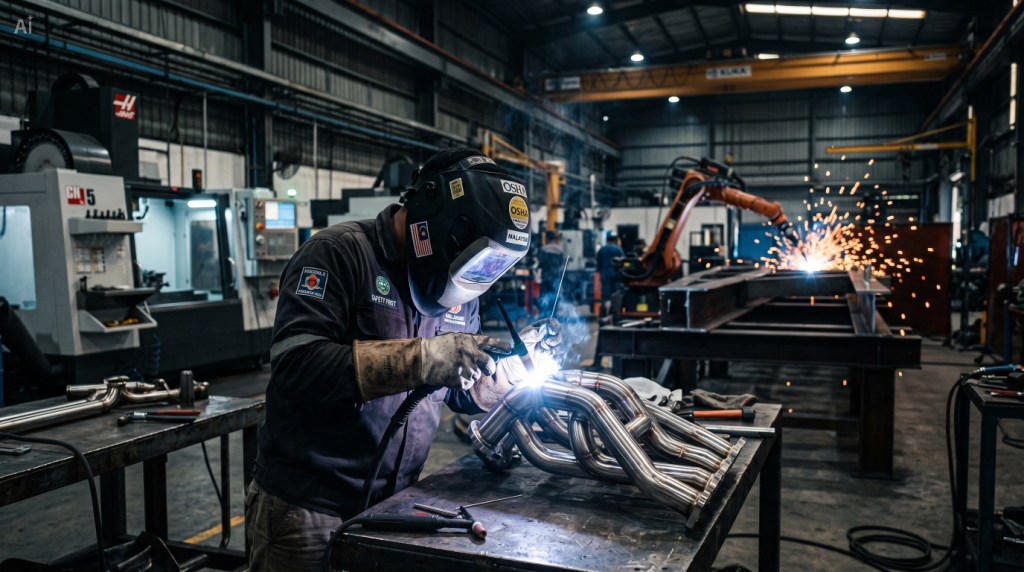
1. Gas Tungsten Arc Welding (GTAW / TIG): For Absolute Precision
TIG welding utilizes a non-consumable tungsten electrode to create the electric arc, requiring the operator to manually feed a separate filler rod into the molten weld puddle.
- Best Suited For: Thin-gauge sheet metal, non-ferrous alloys (like aluminum, titanium, or copper), sanitary stainless steel piping, and high-precision custom tube frames.
- The Engineering Trade-Off: Because TIG welding allows for independent control over both the arc heat and the filler metal addition, it produces exceptionally clean, spatter-free joints with precise cosmetic bead appearances. However, it requires an immense amount of manual dexterity and operates at a significantly slower deposition rate compared to wire-fed processes.
2. Gas Metal Arc Welding (GMAW / MIG): For Heavy Throughput and Speed
MIG welding relies on a continuously fed consumable wire electrode that acts as both the electrical arc source and the filler metal, shielded from atmospheric contamination by an external gas mixture (typically Argon and CO₂).
- Best Suited For: Thick carbon steel structural frames, heavy industrial machinery platforms, and high-volume automated or robotic fabrication cells.
- The Engineering Trade-Off: MIG is the absolute workhorse of heavy metal fabrication. It delivers rapid travel speeds and deep root penetration, making it ideal for thick plates requiring multi-pass welds. The primary downside is the post-weld cleanup required to remove spatter and surface silica islands before the metal can be sent for powder coating or painting.
3. Fiber Laser Welding: The Industry 4.0 Revolution
Fiber laser systems concentrate a highly focused beam of coherent light onto the seam, fusing the base metals almost instantly through extreme energy density.
- Best Suited For: Ultra-thin sheet metal enclosures, mixed-metal assemblies, EV battery busbars, and heat-sensitive electronic component housings.
- The Engineering Trade-Off: Laser welding creates a remarkably narrow Heat-Affected Zone (HAZ). This virtually eliminates thermal distortion, allowing manufacturers to weld complex, tight-tolerance geometries without needing secondary mechanical straightening processes. However, laser welding requires near-zero joint gap tolerances and represents a significantly higher upfront capital investment.
💡 Pro-Tip: Aligning with National Fabrication & Quality Standards
When fabricating load-bearing industrial equipment or pressurized assemblies in Malaysia, your welding operations must comply with strict regulatory frameworks. Ensuring your shop operates using pre-qualified Welding Procedure Specifications (WPS) guarantees your structural joints easily pass mandatory non-destructive testing (NDT) audits.
4. Critical Variables in System Selection
When evaluating a custom metal fabrication project, manufacturing engineers analyze four vital parameters before striking an arc:
- Thermal Conductivity: Materials like copper and aluminum pull heat away from the weld zone rapidly. They require processes with intense, concentrated initial heat input (like high-frequency AC TIG or continuous-wave Fiber Lasers) to prevent cold cracking.
- Material Thickness: Sheet metal under 1.5mm heavily favors TIG or Laser to prevent catastrophic burn-through, while structural plates exceeding 10mm demand the high-amperage deposition rates of Pulse MIG or Submerged Arc Welding (SAW).
- Joint Accessibility: Can a bulky MIG torch or automated laser head physically reach inside the internal gussets of your custom component? If not, manual TIG configurations remain an indispensable necessity.