
In the era of Industry 4.0, traditional manufacturing frameworks are undergoing a massive digital shift. For a long time, industrial conveyor systems were viewed as purely mechanical assets—designed simply to move an object from Point A to Point B.
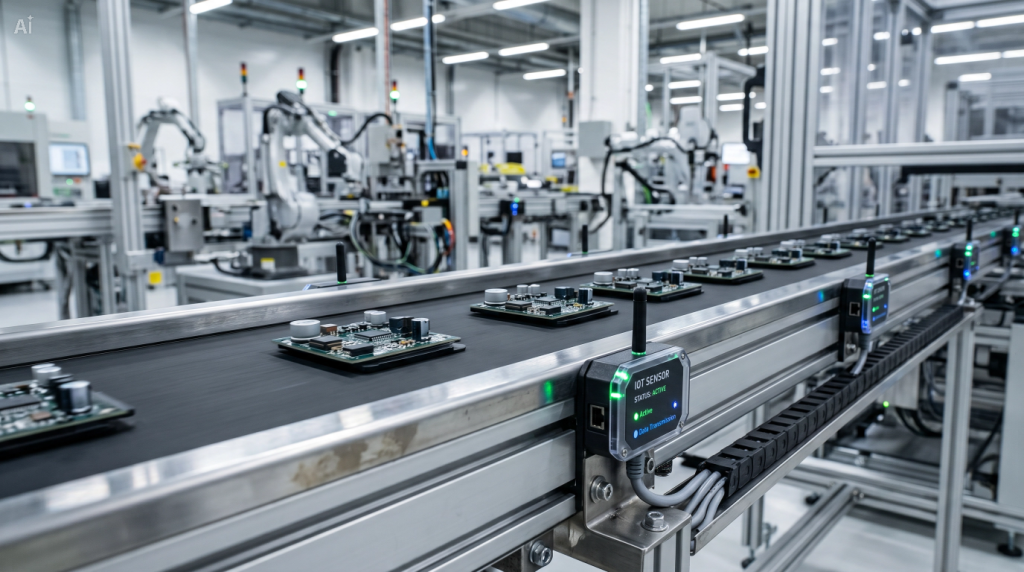
Today, the integration of smart conveyor systems embedded with IoT (Internet of Things) sensors is transforming material handling into an intelligent, data-driven process. By upgrading standard lines with smart automation, factories across Malaysia can eliminate unpredictable downtime, optimize energy usage, and drastically improve tracking accuracy.
1. Shifting from Reactive to Predictive Maintenance
The costliest event on any production line is unexpected mechanical failure. When a primary conveyor motor burns out or a bearing seizes, the entire factory floor can grind to a halt.
Smart sensors completely change this dynamic through continuous monitoring:
- Vibration Sensors: Piezoelectric accelerometers mounted on critical bearings detect minute microscopic changes in structural harmonics long before a human operator can hear or feel a problem.
- Thermal Sensors: Infrared temperature transducers track the heat profiles of gearboxes and drive motors. A sudden rise in temperature triggers an early automated warning, allowing your maintenance team to schedule a fix during off-peak hours.
2. Photoelectric and Proximity Sensors for Intelligent Flow Control
In automated sorting and packaging applications, conveyors must adapt dynamically to varying product sizes, weights, and processing speeds.
Integrating advanced optical arrays allows the line to think for itself:
- Product Counting and Spacing: Photoelectric through-beam sensors track the precise positioning of items, feeding data directly to the PLC to adjust belt speeds and prevent pile-ups at bottleneck zones.
- Automated Sortation: Paired with barcode scanners or RFID readers, smart proximity sensors command high-speed pneumatic pushers or swing-arm diverters to route specific packages to their correct loading docks without human intervention.
💡Pro-Tip: Capitalizing on Malaysia’s Industry4WRD Incentives
Upgrading your factory floor with smart sensors and connected IoT infrastructure aligns directly with Malaysia’s national agenda for digital transformation. Local small and medium enterprises (SMEs) can leverage government grants to offset the cost of transitioning to smart manufacturing.
* Learn more about readiness assessments and funding eligibility directly from the Ministry of Investment, Trade and Industry (MITI) Industry4WRD Framework
3. Achieving Energy Efficiency via “Run-on-Demand” Logic
Traditional conveyor systems run continuously at maximum speed, consuming high levels of electricity even when no products are moving down the line. This leads to excessive power bills and accelerated wear on mechanical components.
Smart conveyors utilize run-on-demand programming. When a photoelectric sensor notices a gap in production, the system automatically dials down the motor speed via a Variable Frequency Drive (VFD) or places the specific conveyor segment into a low-power idle mode. The moment a new part arrives at the entry gate, the system instantly wakes back up.
4. Enhancing Floor Safety with Smart Zoning
Worker safety is paramount in heavy industrial layouts. Smart sensors create an invisible, responsive shield around complex material handling systems:
- Light Curtains: Positioned around high-speed sortation areas or robotic palletizing cells, these sensors instantly cut power to the machinery if an operator’s hand or foot breaks the optical beam.
- Area Scanners: Smart LiDAR scanners monitor the perimeter around moving overhead tracks, automatically slowing down operations if a worker steps into a designated hazard zone.