
Executive Summary
A D.O.E-compliant exhaust system in a clean room safely extracts hazardous Volatile Organic Compounds (VOCs) and toxic effluents without compromising the facility’s strict particulate limits. Achieving this balance requires precision-engineered ductwork and advanced air handling to neutralize the negative extraction pressure against the clean room’s positive laminar airflow.
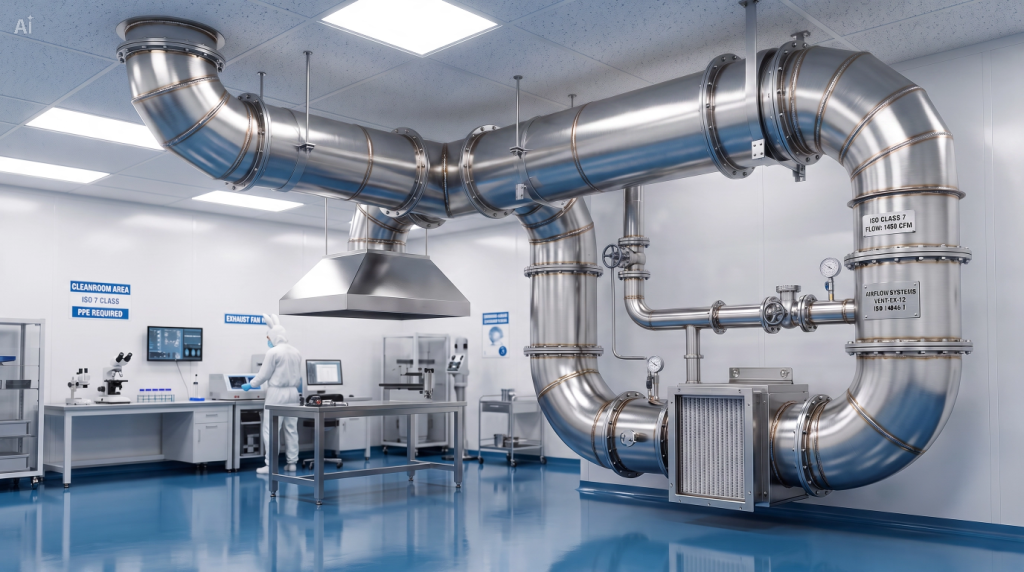
The Core Challenge: Balancing Airflow and Extraction
Clean rooms operate on a fundamental principle of positive pressure. By utilizing HEPA-filtered laminar airflow, the environment continuously pushes air outward, preventing unconditioned, contaminated air from entering the sterile space. Conversely, industrial exhaust systems inherently create negative pressure—they are designed to actively pull hazardous fumes, chemical vapors, and heat away from operators and manufacturing equipment.
Integrating these two opposing forces is the primary engineering challenge. If an exhaust system pulls too much air, it overpowers the clean room’s positive pressure, effectively vacuuming unfiltered micro-particles into the sterile environment. To solve this, extraction systems must be paired with synchronized makeup air units (MAU) and Variable Frequency Drive (VFD) blowers. This ensures extraction rates adapt in real-time, maintaining a net-positive pressure in the room while safely venting toxins.
D.O.E. Compliance and ISO Parameters
When exhausting hazardous materials from a clean room, facilities must adhere to stringent Department of Environment (D.O.E) regulations regarding emissions, as well as international clean room standards. Key engineering requirements include:
- Effluent Scrubbing: Exhaust containing VOCs or acidic vapors must pass through wet scrubbers or activated carbon filtration before being released into the atmosphere, per D.O.E emission thresholds.
- Stack Discharge Velocity: D.O.E guidelines typically require a minimum vertical discharge velocity (often exceeding 15 m/s) to ensure exhaust plumes breach the building’s aerodynamic wake and safely disperse.
- Leak-Tight Ducting: To maintain an ISO-certified environment, exhaust ducts must feature fully welded, leak-tight seams rather than standard mechanical joints to prevent the re-circulation of micro-contaminants.
- Dedicated Segregation: Incompatible exhaust streams (e.g., flammables vs. corrosives) must be extracted through entirely separate, dedicated ducting networks to prevent hazardous internal chemical reactions.
Clean Room vs. Standard Industrial Exhaust Requirements
| System Parameter | ISO Clean Room Exhaust | Standard Industrial Exhaust |
|---|---|---|
| Airflow Dynamics | Must synchronize with Laminar Flow | Turbulent flow acceptable |
| Pressure Balancing | Net-Positive pressure mandatory | Negative pressure acceptable |
| Material Particulate Limits | Zero-shedding required (e.g., 316L SS) | Moderate shedding allowed (e.g., Galvanized) |
| D.O.E. Filtration | Multi-stage Scrubbers + HEPA/ULPA | Standard dust collectors or single scrubbers |
Material Selection for Corrosive Exhaust
The materials used to fabricate the exhaust system are just as critical as the airflow dynamics. Standard galvanized steel is strictly prohibited in these environments due to its tendency to shed zinc particles, which immediately violates clean room particulate counts.t
For volatile or highly corrosive chemical extraction, smooth-bore Grade 316L Stainless Steel is the industry standard. This material provides the necessary chemical resistance while ensuring a smooth internal surface that prevents the buildup of dangerous residues. When deciding on fabrication materials for your facility, selecting the correct grade of stainless steel for corrosion resistance is paramount for both compliance and operational longevity. Furthermore, the entire installation must be validated against ISO 14644-4 standards to guarantee that the design, construction, and start-up of the clean room ventilation system meet global regulatory requirements.