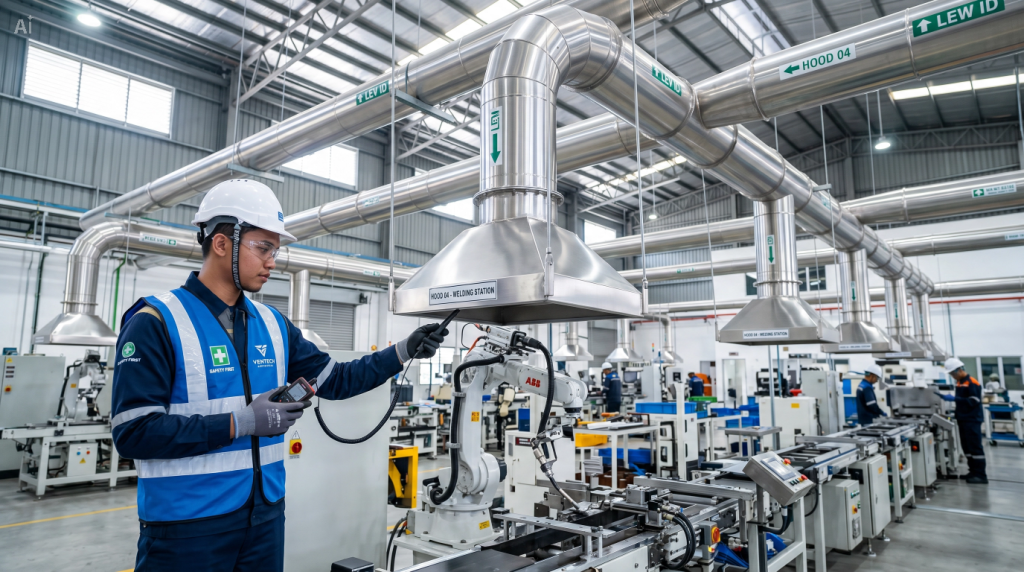
In manufacturing facilities handling chemical baths, metal welding, paint spraying, or solvent cleaning, airborne contaminants pose a direct threat to worker health and environmental safety. Standard dilution ventilation is rarely enough. To capture toxic fumes, dust, and vapors right at the source, industrial plants must deploy engineered Local Exhaust Ventilation (LEV) systems.
However, installing an LEV system in Malaysia is not just a mechanical challenge—it is a strict statutory procedure. A misconfigured extraction line can lead to severe fines or factory stop-work orders from regulatory authorities.
1. The Anatomy of an Efficient LEV System
A high-performance LEV setup is an engineered closed loop designed to pull contaminants away from the operator’s breathing zone before they disperse into the factory air. To meet compliance standards, four core components must be precision-matched:
- Capture Hoods: The physical intake point. The hood must be aerodynamically designed (such as enclosing hoods, canopy hoods, or slotted side-draft hoods) to maintain an adequate capture velocity without interfering with the operator’s workflow.
- Ductwork Network: Smooth, sized ducting designed to maintain minimum transport velocity (typically 15–20 m/s for vapors and 20–25 m/s for heavy dust) so particles do not settle and clog the piping.
- Air Cleaning Devices: Scrubber towers, baghouse dust collectors, or HEPA filtration arrays that strip pollutants from the air stream before discharge.
- Air Movers (Centrifugal Fans): High-static-pressure blowers sized to overcome total system resistance and deliver consistent airflow volume.
2. Navigating Malaysian Regulatory Compliance: DOSH vs. DOE
A frequent point of confusion for plant managers is overlapping regulatory jurisdiction. When installing an LEV system, your engineering team must satisfy two separate government bodies:
| Regulatory Body |
Primary Focus |
Governing Regulation |
Mandatory Action Required |
|
DOSH / JKKP
(Occupational Safety)
|
Indoor air quality & worker breathing zones |
USECHH Regulations 2000 |
System design assessment by a registered Hygiene Technician 1 (HYG1) prior to installation, followed by initial inspection by HYG2. |
|
DOE / JAS
(Environmental Protection)
|
Outdoor chimney discharge & air pollution |
Environmental Quality (Clean Air) Regulations 2014 |
Written notification / permission for Air Pollution Control Systems (APCS) and strict adherence to Emission Limit Values (ELV). |
2. Key Steps to Securing D.O.E and DOSH Approvals
To ensure your facility remains 100% audit-ready and avoids costly retrofits, follow this standardized compliance roadmap during installation:
- Pre-Installation Design Assessment: Before fabricating any sheet metal, your LEV engineering drawings must be calculated and endorsed by a certified professional to verify that airflow volumes and capture velocities meet regulatory baselines.
- Proper Chimney & Stack Sizing: Under DOE (JAS) guidelines, external discharge stacks must be designed to specific heights relative to surrounding roofline structures to prevent atmospheric downwash and ensure safe dispersion of exhaust gases.
- Commissioning & Baseline Testing: Once installed, the system must undergo thorough physical testing—measuring static pressure, hood face velocity, and motor amperage—to establish baseline performance records for future annual inspections.
💡 Pro-Tip: Mastering Statutory Inspection Cycles
Passing your initial commissioning audit is only the first step. Under Malaysian law, all industrial LEV systems must undergo mandatory testing and examination by a DOSH-registered Hygiene Technician (HYG2) at least once every 12 months. Failing to maintain these annual inspection reports is one of the most common triggers for regulatory penalties during surprise site audits.
4. Selecting Corrosion-Resistant Materials
The chemical composition of your exhaust dictates your fabrication materials. Using standard galvanized steel for acid-vapor extraction will cause rapid internal corrosion, duct collapse, and fatal chemical leaks.
For aggressive chemical fumes, plating lines, or wastewater scrubbers, LEV ductwork must be fabricated from chemical-resistant polymers such as Polypropylene (PP), PVC, or specialized 316L Stainless Steel, featuring sealed, leak-proof flanged joints.
Conclusion: Engineering Complete Ventilation Compliance
An LEV system is a critical life-safety and environmental asset. Designing it correctly requires balancing fluid dynamics, structural metal fabrication, and complex statutory frameworks.
At SEIBUTEC Sdn Bhd, we deliver turnkey industrial ventilation solutions. From custom hood fabrication and ductwork routing to complete DOSH and DOE regulatory coordination, we ensure your factory floor remains clean, safe, and fully compliant.