Executive Summary
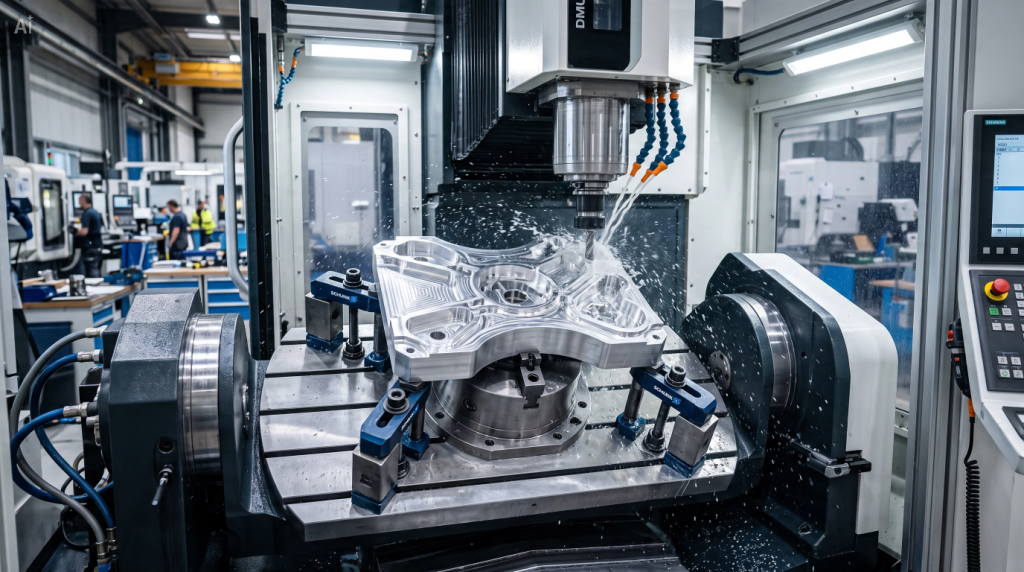
Precision CNC (Computer Numerical Control) machining is the critical foundation of high-quality custom assembly. By utilizing computer-guided cutting, milling, and turning, CNC machining guarantees sub-millimeter tolerances and absolute repeatability. This ensures that complex, custom-fabricated metal components mate seamlessly during final assembly, eliminating costly rework, manual adjustments, and structural vulnerabilities.
The Core Challenge: Tolerance Stacking and Assembly Bottlenecks
In custom industrial manufacturing, the greatest threat to a successful assembly is “tolerance stacking.” When individual components are fabricated using traditional or manual methods, each part has a slight dimensional variance. While a single part might pass inspection, combining multiple slightly off-spec parts in a complex assembly results in misalignments, failing joints, or the need for aggressive on-site modification.
Precision CNC machining eliminates this bottleneck. By programming exact toolpaths based on 3D CAD models, CNC centers machine every slot, thread, and mating surface to exact specifications. When these components reach the assembly floor, they fit together with zero-clearance precision. This is particularly vital in robotic systems, automated manufacturing lines, and hydraulic CNC bending machines, where even a fraction of a millimeter of misalignment can cause mechanical binding or total system failure.
Key Drivers of CNC-Driven Assembly Success
To achieve flawless custom integration, engineering teams rely on several specific advantages inherent to CNC technology:
- Micro-Tolerances: Multi-axis CNC machines routinely achieve tolerances of ±0.005mm, ensuring airtight mechanical fits.
- Absolute Repeatability: Once a custom part is perfected, the CNC program can produce 10 or 10,000 identical units without dimensional drift, securing consistency across batch assemblies.
- Complex Geometries: Modern 5-axis CNC machining centers can mill complex undercuts and angled bores in a single setup, reducing the need to weld multiple smaller parts together.
- Material Integrity: Unlike welding, which can alter the heat-affected zone of a metal, cold CNC machining preserves the raw tensile strength of the base material.
Assembly Impact: CNC Machining vs. Traditional Fabrication
| Assembly Parameter |
Precision CNC Machining |
Traditional Manual Fabrication |
| Dimensional Accuracy |
Sub-millimeter (±0.005mm) |
Variable (±0.5mm to ±1.0mm) |
| Mating & Fitment |
Flawless integration; zero-clearance fits |
High risk of tolerance stacking; requires rework |
| Batch Repeatability |
100% identical across all units |
High variance between individual operators |
| Assembly Speed |
Rapid drop-in assembly |
Slowed by manual grinding and adjustments |
Integrating CNC Parts into the Fabrication Ecosystem
Successfully leveraging CNC parts requires a holistic approach to the manufacturing environment. When integrating CNC-machined components with welded frameworks, the base materials must be carefully considered. For instance, selecting the correct grade of stainless steel or aluminum determines how well the machined parts will withstand environmental stressors once assembled.
Furthermore, all CNC machined components intended for high-stress custom assemblies should be engineered and inspected according to strict global standards, such as the ISO 2768 standard for general tolerances, to guarantee international compliance and long-term mechanical reliability.