Executive Summary
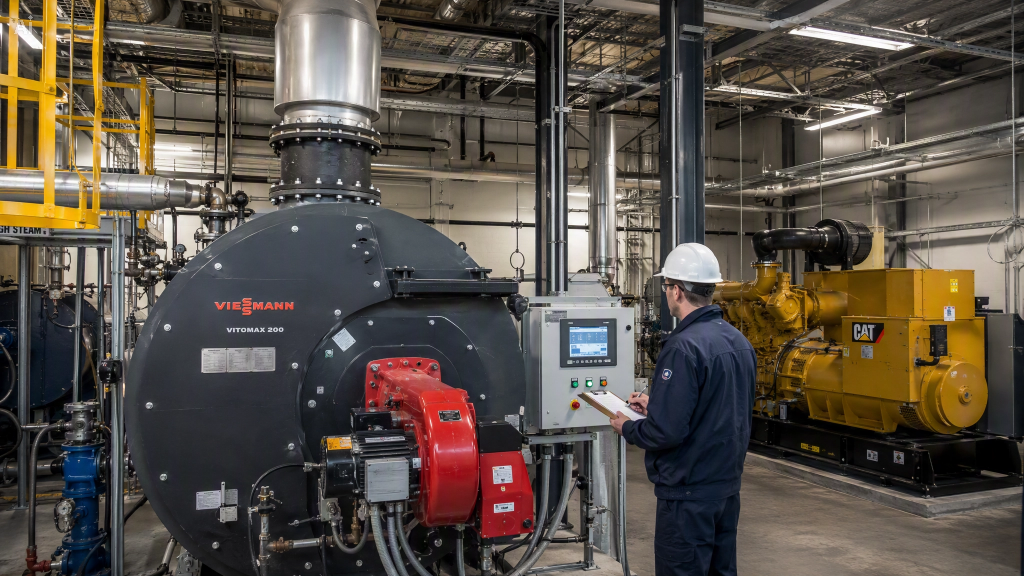
Securing Department of Environment (D.O.E) approval for new industrial boilers and diesel generators is mandatory to ensure fuel-burning equipment meets strict clean air, noise, and effluent standards. Achieving compliance requires a multi-stage process: site suitability assessments, precise chimney/stack height modeling, Written Approval (WA) application submission, and post-installation stack sampling. Following a structured engineering approach prevents project delays and costly retroactive modifications.
The Core Challenge: Regulatory Compliance vs. Project Deadlines
Installing fuel-burning equipment like industrial steam boilers or backup diesel generators involves significant capital expenditure. However, one of the most common bottlenecks in industrial plant commissioning is failing to secure D.O.E Written Approval prior to physical installation.
Operating or installing unapproved fuel-burning equipment exposes facilities to severe legal penalties, immediate stop-work orders, and expensive operational shutdowns. To navigate this, engineering teams must align mechanical design parameters—such as fuel consumption rates, scrubber efficiencies, and chimney discharge velocities—with D.O.E Environmental Quality Regulations before procurement begins.
Step-by-Step Guide to the D.O.E Approval Workflow
- Step 1: Baseline Environmental & Site Assessment Evaluate the proposed installation area against local zoning regulations, adjacent industrial receptors, and prevailing wind patterns. Confirm that ambient noise levels and baseline air quality can accommodate additional fuel-burning emissions.
- Step 2: Engineering Design & Stack Height Calculations Calculate the mandatory chimney stack height based on D.O.E air dispersion modeling guidelines. The stack design must ensure that exhaust plumes breach building aerodynamic wakes to disperse sulfur dioxide (SO2), nitrogen oxides (NOx), and particulate matter safely into the upper atmosphere.
- Step 3: Written Approval (WA) Submission Submit a comprehensive engineering dossier to the local D.O.E authority. This application must include CAD layout drawings, fuel specifications, burner thermal ratings, expected emission concentrations, and acoustic enclosure performance data.
- Step 4: Installation & Pollution Control Integration Once Written Approval is granted, physical installation can commence. Fuel lines, exhaust ducting, wet scrubbers, and baghouse filters must be installed strictly according to the approved engineering blueprints.
- Step 5: Written Notification & Performance Monitoring After installation, submit a Written Notification (WN) to the D.O.E. Schedule an accredited third-party laboratory to conduct initial stack sampling and noise boundary monitoring to verify real-world compliance.
D.O.E Approval Requirements: Industrial Boilers vs. Diesel Generators
| Compliance Factor |
Industrial Steam Boilers |
Standby / Prime Generators |
| Primary Emissions |
Particulate Matter (PM), SO2, NOx, CO |
Diesel Particulate Matter (DPM), NOx, Black Smoke |
| Chimney / Stack Rule |
Height determined by Dispersion Modeling / Fuel Consumption |
Minimum height relative to roofline; vertical discharge cap |
| Required Control Systems |
Wet Scrubbers, Cyclones, or Baghouse Filters |
Acoustic Enclosures, Silencers, Diesel Particulate Filters (DPF) |
| Monitoring Requirement |
Continuous Emission Monitoring (CEMS) / Annual Isokinetic Test |
Initial Dark Smoke (Ringelmann Chart) & Periodic Stack Test |
Integrating Utilities into the Broader Plant Environment
Securing approval for boilers and generators is only one part of total plant environmental integration. If your facility operates clean manufacturing zones, your boiler and generator exhaust systems must be carefully balanced alongside your facility’s internal airflow; integrating high-capacity exhaust stacks must align with D.O.E-compliant exhaust systems in clean rooms to avoid negative pressure imbalances.
Furthermore, managing boiler combustion controls and generator automatic transfer switches (ATS) requires modern digital oversight. If you are integrating new utilities into a legacy facility, consider upgrading your mechanical machinery with modern automation controls
to enable automated air-to-fuel ratio adjustments and continuous emission monitoring (CEMS). Facilities must ensure all equipment complies directly with official regulations set under national environmental law, such as the Malaysia Environmental Quality (Clean Air) Regulations 2014 for fuel-burning equipment compliance.