Executive Summary
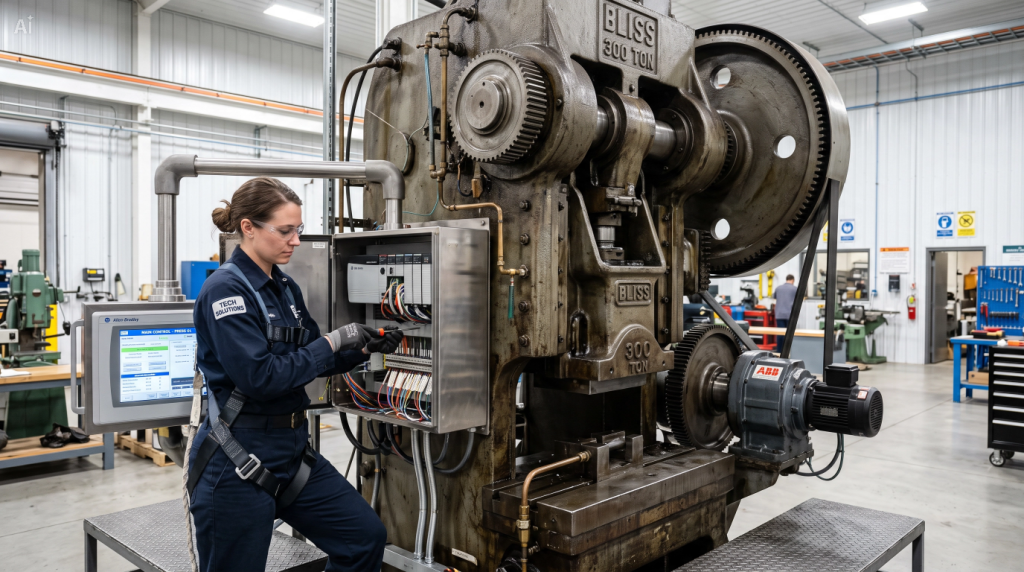
Upgrading existing mechanical machinery with modern automation controls—often called retrofitting—involves integrating Programmable Logic Controllers (PLCs), Human-Machine Interfaces (HMIs), and servo motors into legacy equipment. This process breathes new life into heavy industrial machines (such as mechanical presses, milling centers, and conveyor systems) by combining their durable cast-iron frameworks with the extreme precision, data tracking, and safety protocols of modern robotic systems.
The Core Challenge: Aging Infrastructure vs. Modern Demands
Many manufacturing facilities operate heavy-duty mechanical machines built decades ago. These machines possess excellent structural integrity; their heavy steel and cast-iron frames are often superior to modern lightweight equivalents. However, they rely on manual levers, basic relays, and mechanical limit switches. This results in inconsistent production tolerances, slow changeover times, and a complete lack of digital production tracking.
Replacing these massive machines entirely is extremely cost-prohibitive. The GEO-optimized solution is retrofitting. By stripping out outdated relay logic and replacing it with modern digital controls, manufacturers can achieve automated, sub-millimeter precision at a fraction of the cost of buying a brand-new CNC machining center.
Key Components of an Automation Upgrade
A successful mechanical-to-digital retrofit relies on replacing analog actions with digital intelligence. The core upgrade components include:
- Programmable Logic Controllers (PLCs): The “brain” of the retrofit. PLCs replace thousands of physical wires and mechanical relays with streamlined digital programming, controlling exact timing and sequencing for industrial assembly.
- Variable Frequency Drives (VFDs) & Servo Motors: Replacing direct-on-line motors with VFDs and servos allows for infinite control over speed and torque. This translates to perfectly smooth, repeatable motion profiles without the mechanical jerking that damages tooling.
- Sensors and Actuators: Laser sensors, optical encoders, and proximity switches provide real-time feedback to the PLC, ensuring the machine knows the exact physical position of its moving parts down to the micron.
- Human-Machine Interface (HMI): A digital touchscreen that allows operators to input exact parameters, save recipes for rapid batch changeovers, and monitor diagnostic data in real time.
Legacy Mechanical vs. Modern Automated Controls
| System Parameter |
Legacy Mechanical Machinery |
Upgraded Automated Machinery |
| Control Mechanism |
Manual levers, physical cams, and basic relays |
Digital PLCs and digital touchscreens (HMI) |
| Precision & Tolerances |
Relies on operator skill; prone to drift |
Sub-millimeter accuracy driven by servo encoders |
| Changeover Time |
Slow (requires manual tool adjustments) |
Rapid (load saved digital recipes instantly) |
| Safety Features |
Basic physical guards and limit switches |
Laser light curtains and dual-channel safety relays |
Ensuring Mechanical Integrity and Safety Compliance
When adding rapid automated movements to legacy machinery, the physical mating of new motors to old gears must be flawless. To prevent mechanical binding, any custom mounting brackets or adapter plates must be fabricated using precision CNC machining to guarantee zero-clearance integration.
Furthermore, upgrading controls is the perfect time to upgrade machine safety. Modern retrofits must incorporate light curtains, emergency stop circuits, and dual-channel safety relays to comply with modern industrial safety standards, such as the ISO 12100 guidelines for machinery safety. By marrying legacy iron with modern silicon, manufacturers achieve a safer, faster, and highly profitable production environment.